
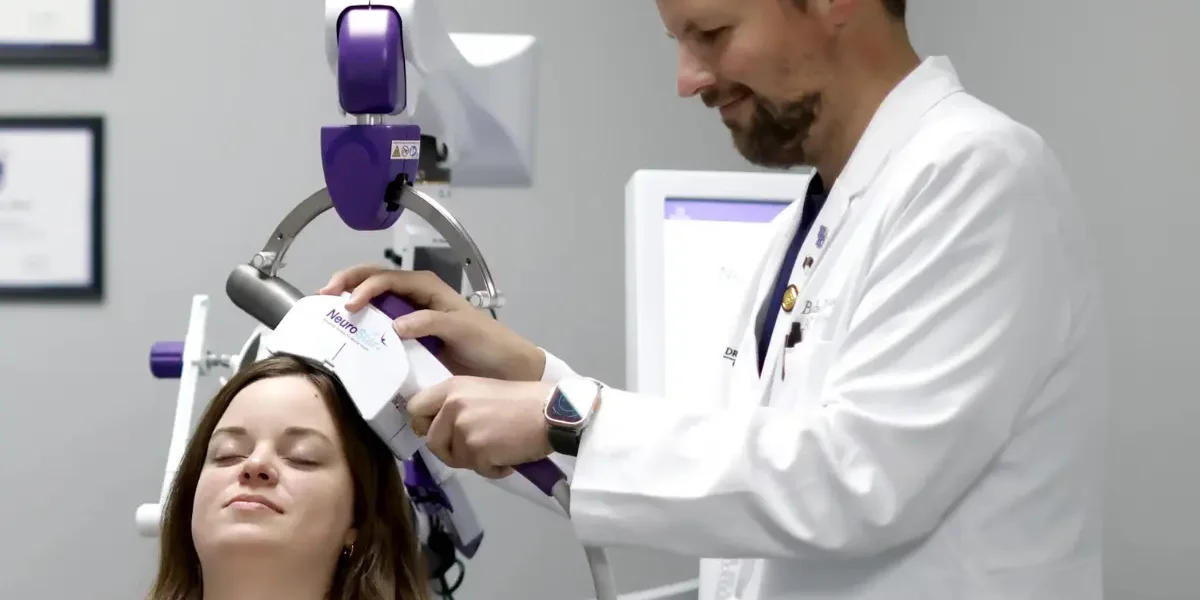
TMS therapy is a noninvasive, FDA cleared treatment that uses magnetic pulses to stimulate the areas of the brain involved in mood regulation. It’s most often used for depression that hasn’t responded to medication or therapy alone. There’s no surgery and no anesthesia involved, sessions typically run 19 to 37 minutes depending on the protocol used, and a full course is usually delivered five days a week over six to nine weeks (a standard Neurostart TMS treatment offered here at Lumera Healthcare locations).
If you’ve tried multiple antidepressants without real relief, you’re not out of options. At Lumera Healthcare, we offer TMS therapy as part of a broader approach to treatment-resistant depression that also includes esketamine and ongoing psychiatric care, so you’re working with a coordinated plan rather than a single isolated procedure.
What Is TMS Therapy and How Does It Work
TMS stands for transcranial magnetic stimulation. It uses an electromagnetic coil placed against the scalp to deliver magnetic pulses into a specific region of the brain tied to mood regulation.
Researchers have studied how TMS affects brain activity for decades, and the underlying science is well established. The coil generates a rapidly changing magnetic field that passes through the scalp and skull and induces small electrical currents in the targeted area of the brain. These currents influence the activity of nearby nerve cells. When treatment for depression involves repeated pulses over a series of sessions, it’s called repetitive TMS, or rTMS.
The exact biology of why this eases depression symptoms isn’t fully mapped out. As the National Institute of Mental Health notes, the antidepressant effects of rTMS aren’t fully understood and researchers are still working to pin down which brain areas produce the greatest clinical improvement. Even so, the effect on brain activity and mood is well documented in clinical research going back to the treatment’s original FDA clearance in 2008.
Who Is TMS Therapy For
TMS therapy is generally recommended for adults with depression that hasn’t improved with standard antidepressant medications and psychotherapy. However, certain systems now have FDA clearance as adjunctive treatment for adolescent MDD in patients ages 15–21. In addition, certain FDA-cleared TMS devices and protocols are also used for obsessive-compulsive disorder, certain migraine headaches, and as an aid in short-term smoking cessation. The appropriate device, treatment protocol, and insurance coverage depend on the condition being treated.
You’re a reasonable candidate to ask about TMS if any of the following apply.
- Multiple medication trials haven’t worked. Most insurance requirements assume you’ve tried several antidepressants first.
- You’ve done therapy without full relief. TMS is often paired with, not a replacement for, ongoing psychotherapy.
- You want to avoid the side effect profile of more medication changes. TMS carries a different set of risks than adding another prescription.
- You’re not a candidate for or don’t want ECT. TMS doesn’t require anesthesia and is not associated with seizures or memory loss.
TMS is most commonly considered after depression has not adequately improved with initial treatments, or when medications have caused unacceptable side effects. The exact eligibility requirements depend on the patient’s clinical circumstances, the TMS device being used, and the insurance plan.
If depression occurs alongside PTSD or significant trauma-related symptoms, ask your provider whether trauma-focused psychotherapy, including EMDR therapy when clinically appropriate, should be incorporated into your treatment plan.
What Happens During Your First TMS Appointment
Your first appointment is longer than every session after it, usually around an hour, because your care team needs to map your individual treatment settings.
Here’s what that mapping process typically involves.
- You’ll sit in a reclining chair and wear earplugs for the session.
- The coil is placed against your scalp and switched on and off to find the exact location that causes a small twitch in your hand or fingers.
- Your provider determines your motor threshold, which is the minimum amount of magnetic energy needed to produce that response. This becomes the baseline dose for your treatment.
Once your motor threshold and treatment location are set, every future session uses those same measurements as a starting point.
What Happens During Each TMS Session
After the first mapping appointment, each treatment session follows the same basic pattern. You sit in a comfortable chair, wear earplugs, and the coil is placed against the treatment location on your scalp.
When the machine is on, you’ll feel a tapping sensation and hear a clicking sound in bursts, followed by short pauses. You stay awake and alert the entire time, and you’re able to drive yourself home afterward. Some people notice mild scalp discomfort or a short-lived headache, but most return to normal activities the same day.
Session length depends on the stimulation protocol your provider uses. Newer theta burst protocols can be as short as a few minutes long, while traditional protocols run closer to 19 to 37 minutes.
How Many Sessions Does a Full Course Require
A standard course of TMS for depression is typically delivered five days a week for about six to nine weeks, which leads to approximately 36 total sessions.
That’s a real time commitment, which is one reason having TMS available locally in Western Kentucky matters. Driving an hour or more each way, five days a week, for six to nine weeks isn’t realistic for most rural families. Some providers (including Lumera Healthcare) also offer tapering “maintenance” sessions after the initial course, spaced further apart, depending on individual clinical need and continued insurance coverage.
Is TMS Therapy Safe
TMS is generally considered safe and well tolerated. Because it doesn’t involve surgery, implanted electrodes, or anesthesia, it avoids several of the risks associated with more invasive brain stimulation treatments.
Common, mild side effects include the following.
- Scalp discomfort or pain at the treatment site during the session
- Headache, usually short-lived and improving with more sessions
- Tingling or twitching of facial muscles
- Lightheadedness during or shortly after treatment
Serious side effects are uncommon but can include seizures, or in people with bipolar disorder, a shift into mania. Long-term effects are still being studied, so your provider will monitor how you respond throughout your course of treatment.
How Effective Is TMS for Treatment-Resistant Depression
Research on standard TMS protocols has found that roughly 6 in 10 people who didn’t respond to other depression treatments respond to TMS, with more than half of those patients still in remission at six-month follow-up, according to Yale Medicine’s Interventional Psychiatry Service. Individual outcomes vary, and this isn’t a guarantee of results for any one person.
Symptom improvement, when it happens, usually takes a few weeks of consistent treatment rather than showing up after the first session. Your psychiatric team will track your symptoms throughout the course so adjustments can be made if needed.
TMS vs. ECT vs. Esketamine: How the Options Compare
All three are used for depression that hasn’t responded to standard treatment, but they work differently.
- TMS uses magnetic pulses, requires no anesthesia, and doesn’t cause seizures or memory loss. Patients drive themselves to and from appointments.
- ECT uses electrical currents to induce a controlled seizure under general anesthesia. It has the longest track record of the three and is generally considered for more severe presentations, but it carries a higher risk of short-term memory effects.
- Esketamine is a nasal spray medication (SPRAVATO™) used alone or together with an oral antidepressant, administered under medical supervision with a required monitoring period after each dose.
*** Psychiatric treatments, including medications and therapy, may involve risks and side effects. This information is provided for outreach and awareness purposes only and does not constitute medical advice. Licensed clinicians and medical providers conduct evidence-based assessments to determine the most appropriate individualized treatment plan.
Lumera Healthcare is an independent provider and is not affiliated with SPRAVATO™ or its manufacturer. Information about esketamine here is for informational purposes only, and SPRAVATO™ is currently offered at our LivingWell (Paducah) and Murray locations.
Does Insurance Cover TMS Therapy
Many insurance plans cover TMS for depression, but coverage typically requires documentation that you’ve already tried a minimum number of antidepressant medications without success.
Coverage for TMS used for OCD or smoking cessation is less consistent across insurance plans, since these are newer approved uses. Our team can help verify your specific benefits before you begin treatment, including options for Medicaid, Medicare, commercial insurance, and sliding scale fees based on family size and income.
TMS Therapy at Lumera Healthcare in Western Kentucky
Advanced psychiatric treatments like TMS are often only available in larger cities, which leaves rural Kentucky families choosing between a long drive or going without. Lumera Healthcare offers TMS therapy at our Paducah and Murray locations, so you don’t have to leave Western Kentucky to access it.
Our approach treats TMS as one part of a connected care model, not a standalone procedure. That means your TMS treatment is coordinated with your psychiatric care, therapy, and any other services you’re already receiving, rather than referred out to a separate, disconnected provider.
If you’re ready to explore whether TMS therapy is the right next step, request an appointment and we’ll walk you through what coordinated, connected care looks like for you.
Bottom Line
TMS therapy is a noninvasive, FDA approved option for depression that hasn’t responded to medication or therapy alone. It requires a real time commitment, typically five days a week for four to six weeks, but it avoids the anesthesia and memory-related risks of ECT and offers a different mechanism than adding another medication.
Research shows a meaningful portion of people with treatment-resistant depression respond to it, though results vary by individual. Lumera Healthcare offers TMS at our Paducah and Murray locations as part of a coordinated treatment plan for depression that hasn’t responded to other approaches.
FAQ
Is TMS therapy painful?
TMS therapy isn’t typically described as painful, though some people notice scalp discomfort or a tapping sensation during the session that eases with more treatments.
How long does a full course of TMS therapy take?
A full course of TMS therapy usually runs five days a week for six to nine weeks, adding up to around 36 sessions total.
Can I drive myself home after TMS therapy?
Yes, you can drive yourself home after TMS therapy, since it doesn’t involve anesthesia or sedation of any kind.
Does TMS therapy require surgery?
No, TMS therapy does not require surgery, implanted electrodes, or any cutting of the skin. It’s delivered through a coil placed against the scalp.
Will insurance cover TMS therapy?
Most insurance plans cover TMS therapy for depression once documentation shows that standard antidepressant treatments haven’t worked, though coverage for other uses varies.
Is TMS therapy the same as ECT?
TMS therapy is not the same as ECT. TMS uses magnetic pulses with no anesthesia or induced seizure, while ECT uses electrical currents under general anesthesia to produce a controlled seizure.
Where can I get TMS therapy in Western Kentucky?
TMS therapy is available in Western Kentucky through Lumera Healthcare’s Paducah and Murray locations.
Disclaimer
TMS is not appropriate for everyone. Before treatment, tell your provider about any history of seizures, head injury, neurological illness, bipolar disorder, implanted medical devices, cochlear implants, metal fragments or clips near the head, and all medications or substances you use. Your treatment team will conduct a safety screening and determine whether TMS is appropriate for you.
The information on this blog is for general educational purposes only and does not constitute medical/mental health advice, diagnosis, or treatment. It does not create a clinician-patient relationship with Lumera Healthcare. Do not use this information to make decisions regarding medication or treatment; always consult a qualified provider.
Emergency: If you are in a crisis, call 911 or the 988 Suicide & Crisis Lifeline immediately.
By reading this blog, you agree that Lumera Healthcare is not responsible for any actions taken based on this content.