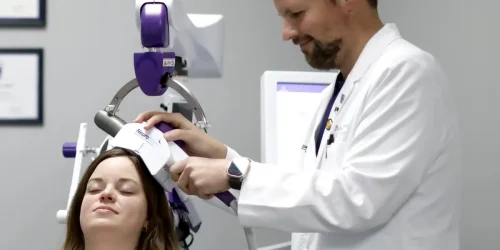


You’ve been in therapy for months – maybe years. You’ve talked about the trauma. You understand it intellectually. And yet your body still flinches at certain sounds. Your heart still races when a memory surfaces. The nightmares haven’t stopped. If traditional talk therapy hasn’t given you the relief you expected, you’re not broken. Your brain may simply need a different kind of help processing what happened to you.
EMDR therapy (Eye Movement Desensitization and Reprocessing) works differently from sitting across from a therapist and recounting your worst moments in detail. We’ve watched this approach change lives for people who believed they’d tried everything. And the research backs it up. More than 30 published randomized controlled trials support EMDR as a first-line treatment for PTSD, and organizations like the World Health Organization, the American Psychological Association, and the Department of Veterans Affairs all recognize its effectiveness.
We’ll walk you through how EMDR for trauma works, what happens during sessions, the science behind bilateral stimulation, and why it may succeed where other approaches haven’t. We’ll also address the most common questions – like whether EMDR is hypnosis (it isn’t) and whether you’ll have to relive every painful detail out loud (you won’t).
Where EMDR Came From and Why It Matters
EMDR therapy was developed in 1987 by psychologist Francine Shapiro, who noticed that certain eye movements seemed to reduce the emotional intensity of disturbing thoughts during a walk in the park. That observation led to years of research and the development of a structured eight-phase treatment protocol used by therapists worldwide.
What started as a PTSD-specific treatment has expanded significantly. A recent editorial in Frontiers in Psychology documented EMDR’s growing evidence base across panic disorders, eating disorders, mood disorders, chronic pain, and even psychosis-related conditions. The therapy has moved well beyond its origins, though trauma treatment remains its strongest area of research support.
How Bilateral Stimulation Works: and Why Your Brain Responds to It
When most people hear “bilateral stimulation,” they picture someone waving their hand in front of a patient’s face. That image isn’t wrong, exactly – but it misses the point of what’s actually happening in the brain.
Here’s what bilateral stimulation actually means. During an EMDR session, your therapist guides you through a rhythmic, side-to-side sensory experience while you hold a distressing memory in your mind. That experience might look like following the therapist’s moving hand with your eyes, holding small handheld devices that alternate vibrations from left hand to right, or listening through headphones as tones shift from one ear to the other. The “bilateral” part refers to how this stimulation moves back and forth between the two sides of your body – and by extension, the two sides of your brain.
Why does that matter? The leading explanation comes from the Adaptive Information Processing (AIP) model. When you go through something traumatic, your brain doesn’t always file that experience away the way it would a normal memory. Instead of becoming something that happened in the past, it stays raw. The emotions, physical sensations, and beliefs attached to the event – the fear, the shame, the feeling that you weren’t safe – get locked in place rather than processed through.
Bilateral stimulation appears to change that. The side-to-side activation engages both hemispheres of the brain at the same time, creating conditions that researchers compare to what happens during REM sleep – the stage where your brain naturally works through and files away the experiences of the day. When a traumatic memory is brought to mind during this state, the brain gets another opportunity to complete the processing it couldn’t finish when the trauma first happened.
The memory doesn’t disappear. You still remember what happened. But the emotional charge – the panic, the shame, the helplessness – fades significantly. People often describe it as watching the memory from a distance rather than being pulled back inside it. That shift is the goal, and it’s one we’ve seen happen in ways that talk therapy alone didn’t produce for many of our patients.
The 8-Phase EMDR Protocol: What Happens in Treatment
EMDR follows a structured eight-phase protocol. Each phase serves a specific purpose, and your therapist moves through them based on your readiness.
- History and treatment planning. Your therapist learns about your background, identifies target memories, and develops a treatment plan.
- Preparation. You learn about EMDR, what to expect, and specific techniques to manage emotional distress between sessions.
- Assessment. Together, you identify a specific target memory and the negative belief connected to it (like “I’m not safe” or “It was my fault”), plus the positive belief you’d rather hold.
- Desensitization. While focusing on the target memory, you follow the bilateral stimulation. Your therapist checks in periodically as the emotional intensity decreases.
- Installation. Your therapist strengthens the positive belief, connecting it to the memory in place of the old negative one.
- Body scan. You mentally scan your body for remaining physical tension related to the memory. If anything comes up, additional processing addresses it.
- Closure. Each session ends with stabilization techniques so you leave feeling grounded.
- Reevaluation. At the next session, your therapist checks how previous processing held up and determines whether additional work is needed.
A typical EMDR session runs 60 to 90 minutes. The number of sessions varies based on what you’re working through. Single-incident trauma – like a car accident or assault – may resolve in as few as 6 sessions. Complex or childhood trauma often requires 12 or more sessions. Your therapist adjusts the pace based on how your brain responds.
What Types of Trauma Does EMDR Treat?
EMDR was originally designed for PTSD, and that’s where the research is strongest. But trauma shows up in many different forms, and EMDR has shown effectiveness across a wide range of experiences.
- Single-incident trauma – car accidents, natural disasters, witnessing violence, physical assault, or a sudden loss. These events create a clear “before and after” in someone’s life and often respond well to a shorter course of EMDR treatment.
- Complex trauma – repeated exposure to harmful situations over time, such as ongoing domestic violence, living with an addicted family member, or sustained emotional abuse. Complex trauma typically requires more sessions because multiple memories need processing.
- Childhood trauma – abuse, neglect, abandonment, growing up in an unstable home, or experiencing events a child’s brain wasn’t equipped to process. These early experiences often form the foundation for anxiety, depression, and relationship difficulties in adulthood.
- Combat and first-responder trauma – repeated exposure to life-threatening situations, loss of fellow service members, and moral injury. A 2025 multisite retrospective review by Fairbanks et al. confirmed EMDR’s effectiveness for veterans in both in-person and telehealth formats.
- Medical and birth trauma – difficult diagnoses, traumatic childbirth, or ICU stays. Research published in the American Journal of Obstetrics and Gynecology (2025) found EMDR effective and safe for postpartum women with traumatic birth experiences.
Beyond trauma, clinicians have reported positive outcomes using EMDR for anxiety, depression with trauma roots, phobias, and chronic pain. A 2024 meta-analysis in Brain Sciences examined 25 randomized controlled trials and found EMDR effective for reducing depressive symptoms with effects that held over time.
The Science Behind EMDR: What the Research Shows
If you want evidence before committing to treatment, EMDR delivers.
A 2024 state-of-the-science review in the Journal of Traumatic Stress summarized the current evidence. Across studies, EMDR produced large effect sizes for PTSD symptom reduction, with remission rates varying widely across populations. Most international clinical practice guidelines now recommend EMDR as a first-line PTSD treatment.
A 2024 meta-analysis by Wright et al. in Psychological Medicine found EMDR equally effective as Prolonged Exposure and Cognitive Processing Therapy. When compared to medication alone, one study found 91% of EMDR patients were PTSD-free at follow-up compared to 72% taking fluoxetine.
Cost-effectiveness matters too. A 2020 PLOS One study ranked EMDR as the most cost-effective intervention for adults with PTSD out of 11 treatments evaluated. A 2025 British Journal of Psychology review confirmed those findings across 29 clinical trials.
“Is EMDR Hypnosis?” and Other Common Concerns
When people first hear about EMDR, certain questions come up almost every time. Here’s what we hear most often at Lumera Healthcare.
Is EMDR a form of hypnosis?
No. During EMDR, you remain fully conscious, alert, and in control. You can stop at any moment. Hypnosis involves an altered state of consciousness – EMDR does the opposite by keeping you grounded in the present while your brain processes past experiences.
Will I have to describe my trauma in graphic detail?
This is one of EMDR’s biggest advantages. Unlike prolonged exposure therapy, EMDR doesn’t demand that you narrate your experience step by step. You hold the memory in your mind, but you don’t have to describe every detail out loud. Your therapist guides the process without needing a full verbal account. For many trauma survivors, this makes EMDR feel safer and more manageable.
Will I feel worse before I feel better?
Some people experience heightened emotions or vivid dreams between sessions as their brain continues processing. This is normal and temporary. Your therapist prepares you with specific grounding techniques to use between appointments.
Does EMDR work over telehealth?
Yes. Research from 2025 confirmed that EMDR delivered via telehealth produces similar outcomes to in-person sessions. Therapists adapt the bilateral stimulation – often using audio tones or guided self-tapping – and the results hold up. This matters for people in rural areas where traveling to a specialist can be a real barrier. It’s something we think about often at Lumera, given how many of our patients are traveling significant distances just to access care.
EMDR vs. Traditional Talk Therapy: How They Compare
Traditional talk therapy – particularly cognitive behavioral therapy (CBT) – has a strong evidence base. So how do the two approaches differ?
- Verbal demands. Talk therapy requires extensive discussion about your experiences. EMDR requires minimal verbal processing of the traumatic material itself.
- Homework. CBT typically involves homework between sessions. EMDR generally does not.
- Treatment length. EMDR often produces results in fewer sessions. A complete course may take 6 to 12 sessions for single-incident trauma, while talk therapy for similar issues often extends across months.
- Mechanism of change. CBT works through conscious cognitive restructuring. EMDR activates the brain’s natural processing system, allowing the memory to integrate without requiring conscious reinterpretation.
- Physical symptoms. EMDR directly addresses physical sensations stored with traumatic memories through the body scan phase.
Neither approach is universally “better.” Some people respond well to one and not the other. The right choice depends on your situation, your comfort level, and what your clinician recommends based on a thorough assessment.
What Specialized EMDR Training Looks Like: and Why It Matters
At Lumera Healthcare, our therapists bring specialized EMDR training to our patients’ stories. We use EMDR and other psychotherapy techniques designed for the kinds of complex trauma we see in Western Kentucky – including addiction-related trauma, childhood abuse and neglect, and the compounded stress that comes with caring for multiple generations of family.
When choosing an EMDR therapist, ask about their training level, how many clients they’ve treated with EMDR, and whether they have experience with your specific type of trauma.
Insurance, Cost, and Getting Started
Most major carriers, including Medicaid, Medicare, Blue Cross Blue Shield, Aetna, United Healthcare, and Cigna, cover EMDR when deemed medically necessary by a licensed provider. Coverage details and copay amounts vary by plan.
At Lumera Healthcare, we accept all major insurance plans, Medicaid, Medicare, EAP, and self-pay options. Our team can help verify your specific coverage before your first appointment.
* Psychiatric treatments, including medications and therapy, may involve risks and side effects. This information is provided for outreach and awareness purposes only and does not constitute medical advice. Licensed clinicians and medical providers conduct evidence-based assessments to determine the most appropriate individualized treatment plan.
Your First EMDR Session: What to Expect
Your therapist will spend the initial session getting to know you – your history, current symptoms, what you’ve tried before, and what brought you in now. This isn’t the session where processing happens. Think of it as building the foundation.
You’ll learn about the EMDR process in detail, practice grounding and relaxation techniques, and have the chance to ask every question on your mind. Your therapist moves at your pace.
For many of the people we serve – caregivers stretched thin between kids and aging parents, individuals in recovery from substance use, survivors who’ve carried trauma for decades – that first session is the moment something shifts. Not because the trauma disappears. But because someone finally says, “We see what you’re carrying, and there’s a way through this.”
If you’ve been carrying something that talk therapy hasn’t resolved, EMDR may be the approach your brain needs. Request an appointment here or call our office. You’ve already done the hardest part – deciding you’re ready.
Disclaimer
The information on this blog is for general educational purposes only and does not constitute medical/mental health advice, diagnosis, or treatment. It does not create a clinician-patient relationship with Lumera Healthcare. Do not use this information to make decisions regarding medication or treatment; always consult a qualified provider. External data is not guaranteed to be accurate.
Emergency: If you are in a crisis, call 911 or the 988 Suicide & Crisis Lifeline immediately.
By reading this blog, you agree that Lumera Healthcare is not responsible for any actions taken based on this content.